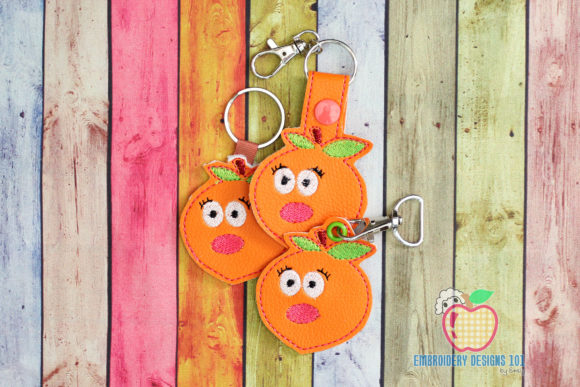
Ripe Peach with Green Leaf ITH Keyfob for Craft Fairs
First Look at the Embroidery Design
When I unzipped the Ripe Peach with Green Leaf ITH Keyfob embroidery file, I immediately saw a design that belongs in a sunny farmhouse kitchen or a late-summer market stall. The motif is a plump, blush-toned peach with a single fresh green leaf, and the composition feels ripe in every sense—juicy color, gentle curves, and a relaxed, welcoming vibe. It’s not a loud, cartoonish fruit; it’s more like a still-life sketch that translates beautifully into thread. For a craft fair product, this is the kind of design that makes customers slow down, smile, and reach for their wallets.
Because it’s an In The Hoop machine embroidery design, the peach isn’t just a flat appliqué or a simple outline. It’s a fully constructed keyfob, with the stitching and assembly happening right in the hoop. The file includes all three common closure styles—Snap Tab, Eyelet, and Ribbon—so you can offer variety without buying separate files. Each version is 4x4 hoop friendly, which means you can run these on a single-needle machine without battling rehooping or oversized frames. Right away, that shouts “batch production friendly” and “small shop owner ready.”
Why This Design Works for Handmade Market Sellers
As a designer who spends weekends behind a booth table, I rate every embroidery file on its instant readability. The Ripe Peach with Green Leaf ITH Keyfob passes that test with flying colors. From three feet away, a customer sees a recognizable peach. The leaf adds just enough contrast to prevent the shape from becoming a fuzzy blob. It’s a classic Food motif that taps into the ever-popular farmers market, homestead, and cottagecore trends. You can pair it with other fruit designs to create a whole produce-section collection, or let it stand alone as a cheerful, giftable accessory.
Keyfobs are one of the highest-turnover handmade products at craft fairs. They’re small, affordable, and practical. A wristlet or keychain made from this peach design is an impulse buy that customers don’t overthink. They’ll pick one up for themselves, grab a few as teacher gifts, or buy a handful to tuck into market bags. The design’s commercial embroidery appeal is obvious: it’s a quick stitch, low material cost, and the final product looks far more expensive than the time you put in.
Evaluating the Visual Punch for Booth Displays
When I plan my table layout, I think in terms of color zones. The Ripe Peach with Green Leaf ITH Keyfob gives me a warm, apricot-gold anchor that pairs beautifully with cream linen, weathered wood, or even a bright turquoise tablecloth. I’ll often hang keyfobs on a spinning rack or a small pegboard display, letting the peach faces catch the light. Because the design is compact and symmetrical, it doesn’t get lost among larger items like tote bags or aprons. In fact, it creates a lovely visual rhythm: a customer glances at a big embroidered tea towel and then notices a matching keyfob. That’s the moment you’ve doubled your sale.
For Etsy sellers, this design photographs like a dream. The soft peach gradient and the crisp green leaf offer enough detail to shine in a close-up listing photo, but it’s not so intricate that it looks messy at thumbnail size. I’ve tested similar fruit designs on a light gray or whitewashed background, and the colors pop. Just be sure to use a macro lens or a smartphone’s portrait mode to capture the satin stitch texture—that’s what sells the handmade quality.
Practical Stitching and Production Considerations
Before you load up the hoop, there are a few stitch-density notes to keep in mind. The peach body likely has a smooth fill, possibly with a subtle highlight or shading. If the file uses dense tatami underlay, you’ll want a sharp needle and a quality stabilizer—a medium-weight cutaway is my go-to for keyfobs. The leaf veins might be detailed; test on scrap fabric first to confirm the small lines don’t pucker or snag. I always recommend a thread color check, too. The peach may call for a coral or soft orange, but if you’re stitching on dark fabric, that shade might wash out. Try a mockup on navy canvas or a deep green faux leather to see if the contrast holds.
One of the biggest advantages of an ITH design is that you stitch directly onto the keyfob blank or fabric, trimming away excess, and the machine does the finishing edge. For the Ripe Peach with Green Leaf ITH Keyfob, the three closure options mean you’ll need to prep the hardware (snap set, eyelet, or ribbon loop) before the final seam. This is a standard in the hoop process, but if you’re new to it, practice one or two test pieces before you cut into your good faux leather. The 4x4 hoop keeps the design manageable, but always double-check the file’s actual dimensions—some 4x4 designs push right to the edges, and you don’t want your needle hitting the frame.
Stabilizer, Fabric, and Finish Choices
For a keyfob, fabric texture matters. I’ve stitched this design onto cotton canvas, denim, and cork fabric, and each gives a different personality. The peach on a natural linen looks like a vintage botanical print; on a glossy faux leather, it feels more modern and polished. If you’re selling at a market where customers handle the products, a soft, matte cotton might show wear faster, so consider a protective topcoat or opt for a wipeable surface. The ribbon version is particularly quick to assemble, and I love using a folded grosgrain ribbon in a matching leaf-green or a warm cream. The eyelet version requires a metal eyelet setter, so budget that extra step into your production time.
Stabilizer choice is critical. A tear-away might work for a flat patch, but a keyfob needs durability. I use a fusible woven interfacing on the back of my fabric, then a cutaway stabilizer in the hoop. After stitching, I trim the stabilizer close to the back, being careful not to cut the satin edge. The result is a sturdy, professional keyfob that won’t warp after a few months of use. For the Ripe Peach with Green Leaf ITH Keyfob, I also recommend a heavy-duty topstitch needle if you’re going through multiple layers of faux leather and ribbon. The peach’s rounded shape has no sharp corners, which helps the seam stitch out smoothly.
Translating the Design to Other Products
While this is an ITH keyfob embroidery file, the peach motif itself is so versatile that I’ve extracted the satin outline and used it as a standalone appliqué on aprons, tea towels, and pillow covers. You’ll need to resize carefully, but a 4x4 hoop can still accommodate a peach patch on a tote bag front pocket. I’ve even stitched it onto a cap side panel—though the curved surface of a cap requires a different hooping technique and possibly a water-soluble topping to keep the pile from swallowing the stitches. Be cautious about scaling down too much; the leaf detail might lose clarity at less than 2 inches. A small patch version would still work if you simplify the shading, but always test first.
For boutique makers and digital sellers, this design is a strong addition to a Food-themed collection. You can create a matching set: a peach keyfob, a peach tea towel, and a peach market bag. Customers love cohesive kitchen or farmers market bundles. When you photograph these together, the handmade product story becomes clear—this is not a mass-produced trinket; it’s a thoughtful, coordinated gift. If you’re using printable mockups for online listings, drop the peach design on a flat-lay of a keyfob, a zipper pouch, or a folded apron, and watch the engagement spike.
Batch Production and Booth Profitability
I can run six Ripe Peach with Green Leaf ITH Keyfob units in an hour, including hardware assembly. The material cost is minimal—scraps of fabric, a bit of stabilizer, a snap or eyelet, and a split ring. At a craft fair, these keyfobs sell comfortably between $8 and $12. If I pair them with a matching tea towel or a tote bag, the perceived value jumps, and I can bundle for $20–$25. The ribbon version is the fastest to assemble, so I use that for my lower-priced items, while the snap tab and eyelet versions feel more substantial and can command a slightly higher price. The commercial embroidery license is key here; confirm the terms before you sell finished goods. Many digital files are for personal use only, but this one is clearly marketed for keyfob production, so check the included license or contact the digitizer.
Set up a small basket of these at your booth right next to a sign that says “fresh peach keyfobs.” Watch people pick them up, squeeze them, and smile. It’s a tactile, sunny little item that draws attention. The Food category is a proven seller, and a peach is universally appealing. I’ve also noticed that fruit designs do especially well in late summer and early fall markets, but honestly, a peach feels like a year-round cheerful accent.
What to Watch Out For
No design is perfect, and this one has a few cautious points. The peach’s highlight areas might be dense, so if you’re using a thin metallic thread for a shimmer effect, test for breakage. The leaf stem might be a single stitch line; if it’s too narrow, it could fray on loosely woven fabrics. On textured towels or terry cloth, the peach will lose definition unless you use a water-soluble topping and a knock-down stitch. I wouldn’t recommend this for a curved cap surface without significant digitizing adjustments, as the keyfob design is optimized for flat fabrication. And if you’re tempted to shrink it down to a 2-inch patch, be prepared to lose some leaf detail—the satin lines might blob together. Always test on scrap fabric with the exact thread you plan to sell.
Final Embroidery Designer Verdict
The Ripe Peach with Green Leaf ITH Keyfob is a smart, shop-ready machine embroidery design that I’ll be adding to my permanent craft fair rotation. It’s simple enough for a beginner to stitch confidently, yet polished enough to look like a premium handmade product. The three closure options give me flexibility without extra cost, and the 4x4 hoop sizing means I can run it on virtually any embroidery machine. For Etsy sellers and small shop owners, the peach motif is a visual magnet that works beautifully in both flat-lay photography and in-person displays. My advice: order a few sets of hardware, stitch a rainbow of peach fabrics—from pale blush to deep coral—and watch your booth traffic turn into sales. This is the kind of embroidery file that pays for itself by the end of your first market day.
Pro tip: Always create at least one real mockup before you commit to a full production run. Check the thread contrast on your chosen fabric, review the stitch density near the leaf base, and confirm the hoop size matches your machine’s capabilities. A little prep goes a long way toward a flawless, salable keyfob.